
No Token Chuck E. Cheese Economy: Digital Dollars, Fiat Currency, Worthless Tickets: A Behavioral Economics Perspective
Posted on 07/22/2025
by Neil Andrew Lemons
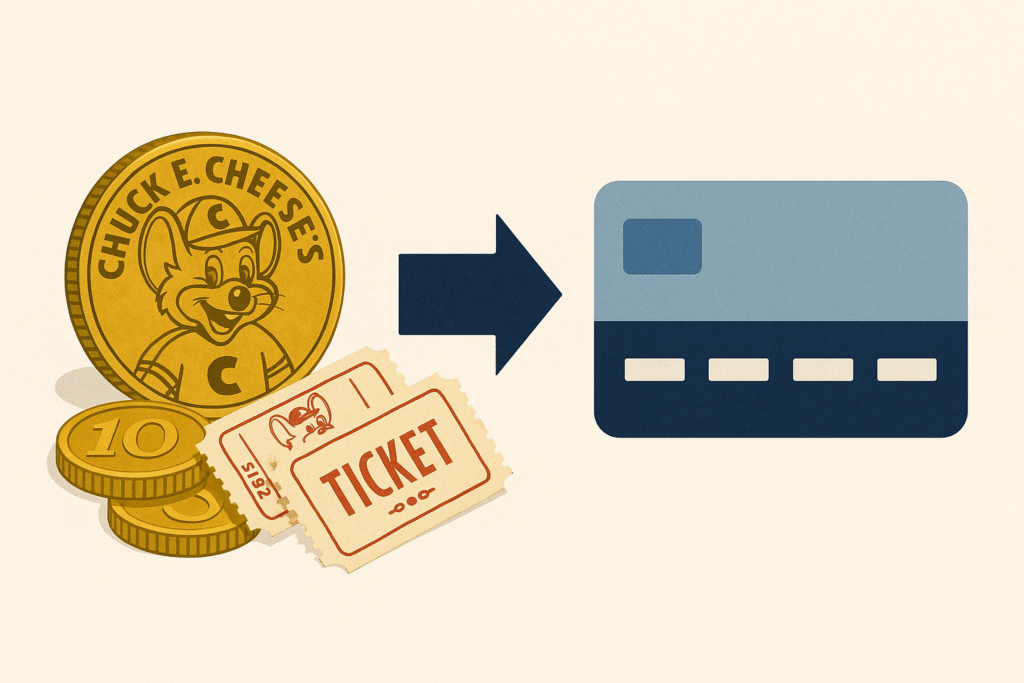
This post explores the parallels between the evolution of monetary systems and the shift in payment models within the Chuck E. Cheese entertainment economy. By examining the transition from physical tokens and tickets to digital swipe cards, we draw comparisons to the transition from tangible currency to fiat money and now to Central Bank Digital Currencies (CBDCs). This analysis applies established behavioral economics frameworks to demonstrate how abstraction of value facilitates greater consumption, diminishes transparency, and enhances institutional control, with significant implications for individual economic autonomy and systemic stability.
Monetary systems have evolved from commodity-backed currencies to fiat currencies and are now progressing towards central bank-issued digital currencies. This evolution follows a behavioral pattern observable in controlled environments like arcades and entertainment centers, notably Chuck E. Cheese, which moved from a token-based economy to swipe cards. Understanding the psychological effects of such transitions provides insights into modern monetary policy and consumer behavior.
Abstraction of Value and Spending Behavior
Richard Thaler’s concept of “mental accounting” (Thaler, 1985) highlights how individuals compartmentalize money based on its perceived source and use. Physical tokens and tickets at Chuck E. Cheese created a sensory and tactile link to spending, encouraging awareness of consumption. With the introduction of swipe cards, spending became abstract, reducing the “pain of paying” and increasing discretionary outlays (Hsee & Rottenstreich, 2004). Similarly, the shift from tangible currency to fiat money, and further to CBDCs, detaches individuals from the physical representation of value, fostering increased consumption and reducing perceived financial discipline.
Inflation Mechanisms and Denominational Drift
Entertainment centers like Chuck E. Cheese employed nominal price increases and ticket devaluation without altering the perception of cost, a phenomenon comparable to the hidden inflation in fiat systems. After abandoning the gold standard in 1971, the U.S. dollar experienced significant inflation, with CPI increases exceeding 600%. This “denominational drift,” where more units are required for equivalent value, parallels the increase in tokens or tickets needed for games or prizes. The transition to digital money accelerates this process by eliminating physical limitations on currency expansion.
Surveillance and Behavioral Control
Swipe cards enabled Chuck E. Cheese to monitor individual spending habits and adjust their internal reward systems. Similarly, CBDCs provide governments with tools for unprecedented financial surveillance and behavioral manipulation, including programmable money features such as expiration dates and spending restrictions (BIS, 2021). This shift raises concerns over privacy, autonomy, and the potential for coercive policy tools within monetary systems.
The “Fun Money” Effect and Liquidity Illusion
The “fun money” effect (Prelec & Loewenstein, 1998) describes how non-traditional forms of payment reduce the psychological cost of spending. Chuck E. Cheese capitalized on this phenomenon, encouraging higher transaction volumes. The Federal Reserve’s use of quantitative easing, coupled with digital transaction methods, mirrors this strategy on a macroeconomic scale, contributing to asset inflation and speculative market behavior.
Conclusion: Manufactured Consent Through Abstraction
The abstraction of money, observed in microcosm at Chuck E. Cheese, reflects a broader societal shift towards diminished financial transparency and increased behavioral control. While marketed under the guise of convenience and technological progress, these transitions facilitate higher consumption, weaken savings behavior, and enable greater institutional control over individual financial choices. Understanding these mechanisms is crucial for assessing the long-term impacts of CBDCs and preserving economic liberty.
Article prompted by Neil Andrew Lemons. Learn more about the history of precious metals, including the historic gold price, silver price, and platinum price, at GoldAndSilverMint.com.